

The Mindset Shift Every Service Provider Must Make Why Mindset Matters More Than Skills Most service providers focus on improving their technical skills or marketing tactics. And yes, skills are important—but mindset dictates how you position yourself, attract clients, and scale your business. Consider this: two freelancers may have identical skills, but one earns twice as much as the other. Why? It’s often due to mindset differences around pricing, value, and self-perception. A growth-oriented mindset helps you: Price your services with confidence, without underselling your value Attract the right clients instead of pursuing every opportunity Lead with strategy instead of reacting on impulse Establish clear boundaries to safeguard your time and energy The Core Mindset Shift: From “Service Provider” to “Problem Solver & Authority” The biggest mindset shift is moving from thinking of yourself as “just a service provider” to positioning yourself as a problem solver and authority in your niche. Most service providers get stuck in one of these common mindset traps: The Short-Term Thinking Trap – Viewing each project as a one-time task, not a long-term opportunity. The Over-Accommodation Trap – Agreeing to everything, even low-value or misaligned work. The Comparison Trap – Focusing on competitors instead of strengthening your unique positioning. Shifting to a problem-solver mindset means focusing on the results your clients want, not just the tasks you perform. You move from being a vendor to being a trusted partner or expert. Example: Transactional mindset: I’ll design this website for ₹5,000” Problem-solver mindset: “I’ll design a website that increases your leads by 30%, and here’s the roadmap to do it.” This simple shift changes how clients perceive your value—and how much they’re willing to pay for it. Step 1: Focus on Outcomes, Not Hours Many service providers continue to trade hours for money. While hourly pricing feels secure, it caps both income and scalability. A better approach is to structure your services around results and outcomes. Example: Hourly approach: “I’ll spend 20 hours creating your social media strategy for ₹8000.” Outcome-based approach: “I’ll create a 90-day social media strategy designed to increase engagement by 50% and attract ideal clients—for ₹15,000.” Outcome-based pricing positions you as a strategic partner, not just a worker, and opens doors to higher-paying clients. Step 2: Establish Credibility Through Expertise Clients don’t just hire skills—they hire confidence and credibility. By sharing your knowledge through content, webinars, workshops, or case studies, you position yourself as a trusted authority they recognize and rely on. Practical Example: A freelance graphic designer could post “Before & After” client projects on Instagram, highlighting results and process. A business consultant could write LinkedIn posts analyzing common mistakes in their niche, showing potential clients, they understand their challenges deeply. When clients see your authority, they’re more likely to pay premium rates and respect your recommendations. Step 3: Choose Clients Strategically Growth isn’t about accepting every opportunity—it’s about choosing the right ones. Saying yes to everyone drains time, energy, and profitability. Shift your focus to clients who understand your value, trust your process, and are willing to pay for meaningful results. Practical Example: A marketing consultant used to take every small business client that came along. Revenue was steady but exhausting. After defining an ideal client profile (mid-size SaaS companies needing lead generation), the consultant increased rates and reduced workload by 40%, while revenue doubled. The mindset shifts here: “I don’t need every client—I need the right clients.” Step 4: Build a Real Business, not a Side Hustle Many service providers unknowingly operate their work like a side hustle instead of a real business. This limits growth and keeps everything reactive. The real shift happens when you start investing in systems, marketing, and structured processes that support scale. Practical Example: Before: A freelancer handles all client communication on WhatsApp, with no contracts, timelines, or defined workflows. Projects feel scattered and stressful. After: The same freelancer adopts project management tools, introduces formal contracts, and sets up an automated onboarding process. Clients experience a higher level of professionalism, and the freelancer can manage more projects without overwhelm. By building structure, you move from daily firefighting to intentional, long-term growth—where your business supports you, not the other way around. Step 5: Value Yourself and Your Expertise At the heart of mindset is self-worth. If you undervalue yourself, clients will too. Practical Examples: Instead of lowering prices to get a client, highlight the ROI your services provide. Instead of apologizing for your rates, confidently explain the results clients can expect. When you truly value your expertise, you attract clients who do the same. How to Implement This Mindset Shift Audit Your Mindset Identify beliefs that limit your growth around money, clients, or your skills. Writing them down makes it easier to challenge and reframe them. Set an Outcome-Focused Goal Pick a measurable goal that drives results, like increasing your average client value by 25%. Focus on outcomes, not just activity. Create Authority Content Weekly Share insights, tips, or success stories consistently. This builds recognition and positions you as the expert in your field. Define Your Ideal Client Know who they are, what they value, and the results they’re seeking. This clarity helps attract clients who align with your work. Review Pricing and Packages Move away from hourly or task-based pricing. Offer results-focused packages that reflect your expertise and value. Conclusion: The Mindset Shift Every Service Provider Must Make The most successful service providers don’t just work harder—they think bigger. Shifting your mindset from “service provider” to trusted problem solver and recognized authority transforms how clients see you, how you price your services, and how your business grows. Start with one small step—refine your pricing, focus on the right clients, or share your expertise this week. These shifts may feel subtle at first, but over time they compound into freedom, higher income, and a business that runs on your terms—where you lead, not just execute. “When your mindset shifts, your business evolves—and so does the way clients experience your expertise.”
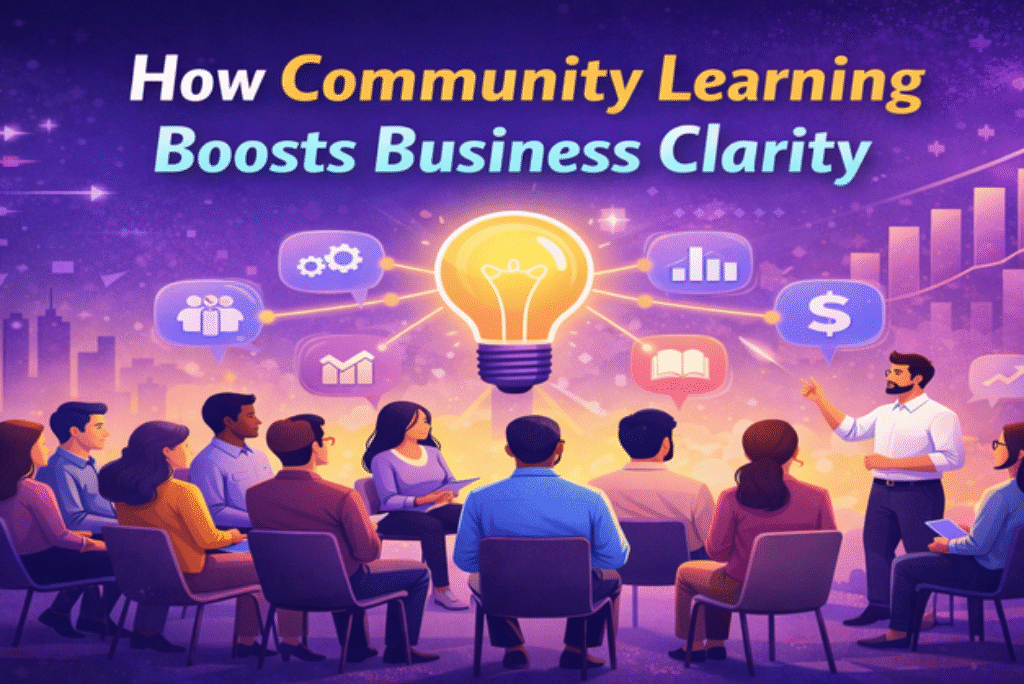
How Community Learning Boosts Business Clarity Community Learning Boosts Business Clarity — because real growth happens through shared insight. In today’s fast-moving business world, entrepreneurs are constantly learning—new tools, new strategies, new trends. Yet despite consuming endless information, many still feel stuck, overwhelmed, or unsure about their next step. The problem isn’t a lack of knowledge. It’s a lack of clarity. This is where community learning becomes a powerful growth catalyst. Community learning boosts business clarity by replacing isolation with shared insight, confusion with perspective, and hustle with alignment. When entrepreneurs learn together, clarity accelerates—and so does sustainable growth. The Clarity Gap That Holds Back Business Growth Many entrepreneurs believe that working harder or learning more will fix their challenges. But in reality, too much information without focus creates mental clutter. You can stay busy all day and still feel uncertain about: Your true business direction • Which strategies actually drive results • Whether your efforts are making an impact • What to prioritize, improve, or stop When you build alone, it’s easy to confuse movement with progress. Clarity doesn’t come from doing more—it comes from understanding what truly matters and acting on it. What Is Community Learning in Business? Community learning is a structured or informal environment where entrepreneurs, founders, or professionals learn together by sharing: Real experiences Practical challenges Proven workflows Honest feedback Lessons from failures and wins Unlike courses or one-way learning, community learning is interactive, contextual, and experience-driven. It allows you to learn not just from experts—but from peers who are actively building businesses like yours. How Community Learning Boosts Business Clarity Brings Fresh Perspective to Blind Spots As entrepreneurs, it’s easy to get stuck in our own routines and assumptions. What feels normal to us may actually be slowing growth—or causing misalignment. Take Maya, a small business owner, for example. She had been following the same marketing strategy for months, convinced it was working. But her results were plateauing, and she couldn’t figure out why. During a community learning session, a peer asked a simple question: “Have you considered how your messaging might be confusing new customers?” That one observation instantly highlighted a blind spot Maya had been too close to see. Fresh perspectives like this help entrepreneurs step back, see what’s been normalized, and make smarter, faster decisions. In a community, clarity doesn’t just happen—it’s accelerated. Replaces Guesswork with Real Experience Trying every new strategy or tool on your own can feel like guesswork. You might wonder: “Will this work for my business?” or “Am I wasting time?” Community learning removes the guesswork. Entrepreneurs share real experiences, successes, and failures. For example, Raj, an e-commerce founder, was debating two email marketing platforms for weeks. After discussing with his community, he realized one tool would integrate better with his existing workflow. That simple insight saved him weeks of trial and error. Learning from real-world experiences turns uncertainty into actionable direction—and accelerates progress. Sharpens Decision-Making Through Honest Feedback Isolation can make decision-making stressful. Every choice feels critical, and second-guessing becomes constant. During a group session, Priya, a service-based entrepreneur, shared her pricing model with peers. Honest, constructive feedback helped her see that her packages were too complex, confusing potential clients. Implementing suggestions from the community immediately simplified her offerings—and boosted client engagement. When multiple trusted voices reflect similar insights, your decisions become clearer, faster, and more confident. Shows You What to Stop Doing One of the most powerful lessons from community learning is: It doesn’t just teach you what to do. It teaches you what to stop doing. An entrepreneur, Arjun, spent months hopping between social media platforms to grow his brand. During a community session, he realized he didn’t need to be everywhere—just where his audience was most active. By stopping unnecessary efforts, he regained focus, energy, and clarity. When entrepreneurs learn together, they realize: Not every trend needs attention Not every tool is necessary Not every strategy fits every business Community learning teaches subtraction, not just addition. It helps you focus on high-impact actions, saving time and reducing overwhelm. Turns Ideas into Aligned Action Ideas are easy; aligned action is rare. Many entrepreneurs have a long list of initiatives but struggle to implement them effectively. In a peer session, Neha shared her plan to launch a new product line. Through group discussions, she prioritized the steps, identified potential bottlenecks, and created a simple action plan. By the next month, her product launch was on track—and results were tangible. Shared learning helps transform scattered ideas into focused, aligned, and executable strategies. Reduces Isolation and Builds Sustainable Growth Entrepreneurship can feel lonely. The mental load of running a business often leads to burnout. Community learning provides emotional support along with strategic guidance. When entrepreneurs share their challenges, they realize they are not alone. Motivation rises, resilience strengthens, and clarity becomes easier to maintain. Sustainable growth isn’t just about systems—it’s about the community that supports those systems. SEO Benefits of Community Learning for Modern Businesses From a digital and SEO perspective, community learning supports long-term growth by helping businesses: Clarify brand messaging Align offers with real audience needs Create consistent, focused content Build authority through shared insights Clear businesses communicate better—and clarity improves visibility, trust, and conversions. Why Community Learning Is a Growth Shortcut When entrepreneurs learn in isolation, clarity comes slowly, if at all. Community learning accelerates the process by combining: Fresh perspectives Real-life experiences Honest feedback Actionable insights Emotional support Because clarity multiplies when learning is shared. As the saying goes: “Your next breakthrough is often just one conversation away.” By learning together, entrepreneurs reduce guesswork, focus on what matters, and gain a clear path forward. Conclusion: Grow With Clarity, Not Confusion Community learning is not just a support system—it’s a strategic growth tool. In a world that celebrates hustle, community learning brings alignment. In a world full of noise, it brings focus. If you’re feeling stuck, overwhelmed, or unsure of your next step, don’t ask, “What more should I do?” Ask instead, “Who
Why Simplifying Your Business Often Brings Faster Results Did you know that simplifying your business often leads to faster results? The business owners who were getting the fastest results weren’t the busiest ones. They weren’t launching five offers, posting on ten platforms, or juggling endless tools. They were doing fewer things—but doing them exceptionally well. That’s when clarity hit: Results don’t come from doing more—they come from simplifying what truly matters. In a hustle-driven world, complexity is often mistaken for growth. Business owners keep adding—services, tools, platforms, strategies—believing more will create momentum. But sustainable growth begins with simplifying what matters most and executing it exceptionally well. Simplifying your business is one of the most powerful—and underrated—growth strategies. When done intentionally, simplification leads to clarity, focus, speed, and measurable results. The Hidden Cost of Complexity in Business Complexity creeps in quietly, it slows growth You add a new service because a client asked for it. You join another platform because “everyone’s there.” You try a new strategy because it worked for someone else. Soon, your business looks full on the outside—but feels heavy on the inside. Complexity Creates: Slower decision-making Scattered focus Inconsistent messaging Team exhaustion and disengagement Confused customers When your business is complicated, progress feels heavy. Every action takes longer, every change feels risky, and results take time to show up. Why Simplicity Accelerates Business Growth Simplification removes friction. And in business, less friction equals faster momentum. Here’s how simplifying your business directly impacts speed and results: 1.Clarity Makes Decisions Effortless When your business is simple, decisions stop draining you. You’re no longer asking: “Which offer should I promote today?” “Who exactly am I talking to?” “Which tool should I use now?” You already know. Your offer is clear. Your audience is clear. Your goal is clear. Clear offerings, clear audience, clear goals = faster execution. And clarity speeds everything up. Businesses that grow quickly are not always smarter—they are clearer. 2. Focus Is the Real Growth Hack Most businesses don’t fail because they lack ideas. They fail because they chase too many at once. When you simplify, you’re forced to focus. One main offer. One clear audience. One primary platform. Suddenly, your effort goes deeper—not wider. And depth is where real results come from. Depth beats width in early and mid-stage business growth. Focused businesses: Execute better Learn faster Improve consistently See results sooner 3. Simple Businesses Are Easier to Understand (and Buy From) Think about the brands you trust instantly. They don’t confuse you. They don’t over-explain. They don’t try to do everything. If your website, LinkedIn profile, or pitch tries to explain everything you do, your audience struggles to understand how you help them. However simple businesses communicate: One clear problem One strong solution One clear next step (CTA) When customers instantly “get it,” trust builds faster— And trust is what converts. 4. Simplified Systems Save Time and Energy Here’s something no one talks about enough. Every tool you add takes mental space. Every process you complicate steals time. Simplified businesses use: Fewer tools Cleaner workflows Repeatable systems That means less firefighting and more growth-focused work. You don’t need more productivity hacks. You need fewer moving parts. This reduces: Decision fatigue Training time Operational errors As a result, you spend less time managing and more time growing. 5. Simplicity Improves Consistency (and Consistency Builds Results) Growth isn’t driven by one big move—it’s built through consistent small actions. Complex businesses lose momentum because processes change, messaging shifts, and teams feel overwhelmed. Simplification creates stability. And consistency in: Content Marketing Client experience Service delivery …are what compounds into faster, sustainable results. Why Overcomplication Feels Productive (But isn’t) Let’s be honest. Complexity feels like effort. It looks like ambition. More strategies. More plans. More action. But activity isn’t progress if it lacks direction. Simplifying doesn’t mean lowering standards. It means choosing impact over noise. What Simplifying Actually Looks Like Simplification isn’t dramatic. It’s intentional. It looks like: Removing services that drain energy Saying no to platforms that don’t convert Strengthening one offer instead of launching five Refining your message until it’s impossible to misunderstand Growth often comes not from adding—but from subtracting. Simplifying doesn’t mean doing less—it means doing what matters most. How to Simplify Your Business (Practical Steps) Here are actionable ways to simplify without slowing down: 1. Streamline Your Offerings Ask yourself: Which service generates the highest revenue? Which service delivers the strongest results? Which service clients value the most? Focus on your core offer. Pause or eliminate the rest. Specialization drives faster, more sustainable business growth than diversification. 2. Clarify Your Ideal Audience Trying to serve everyone slows growth. When your ideal client is clearly defined: Marketing becomes easier Messaging gets sharper Sales conversations get shorter One clear audience builds trust faster and converts quicker. 3. Simplify Your Marketing Channels You don’t need to be everywhere. Choose: One primary platform (e.g., LinkedIn) One core content style (posts, blogs, videos) One main CTA Master one channel before expanding. 4. Build Simple, Repeatable Processes Document: How you onboard clients How you deliver services How you follow up Clear processes replace constant decisions and create room for growth. Simplify Your Messaging Your business message should answer in one sentence: Who you help What problem you solve How you solve it If it takes a paragraph to explain, it’s time to simplify. Real Growth Comes from Subtraction Many successful businesses didn’t grow by adding more—but by removing what didn’t work. They simplified: Their offers Their strategy Their messaging Their operations And in doing so, they created space for focus, creativity, and speed. Simplicity is not a lack of ambition. It’s strategic discipline. Conclusion: Simple Businesses Move Faster If your business feels stuck, overwhelmed, or slow, the solution may not be a new strategy—but a simpler one. Simplicity isn’t a shortcut. It’s a strategy. A disciplined one. Ask yourself: What can I remove? What can I streamline? What deserves my full focus right now? Because when your business becomes easier
How to Thrive as a New Entrepreneur with Few Clients Doubt says, “What if I fail?” Confidence says, “What if I grow?” Every entrepreneur begins with doubt—Am I good enough? Will clients come? Doubt is natural at the beginning, but it doesn’t have to define your journey. The real shift happens when you turn those doubts into confidence, building it step by step, client by client. Starting out as a new entrepreneur can feel like you’re excited about the possibilities, but nervous about the uncertainty. One of the biggest challenges early on is having only a few clients. Instead of seeing this as a setback, you can turn it into your biggest advantage 1. Quality over Quantity With a smaller client base, you have the chance to give each person dedicated attention. By exceeding expectations, understanding their needs, and nurturing genuine relationships, you create loyal clients who not only come back but also become your strongest source of referrals. 2. Build strong foundations Fewer clients = more time. Use it wisely to: Build your personal brand through LinkedIn and social platforms. Refine your offers, packages, or pricing. Streamline operations to scale efficiently later. 3. Experiment & learn With fewer commitments, you can experiment fearlessly. Test new ideas, gather feedback, and adapt quickly. The agility you have now will be harder to maintain once you’re fully booked. 4. Focus on Trust Over Transactions Clients don’t just buy services; they buy confidence in you. Be consistent, transparent, and authentic. Show not just what you sell, but why it matters. Trust brings referrals, collaborations, and long-term growth. 5. Build Confidence Along the Way Confidence comes from doing the work, not from waiting for the crowd. It grows every time you: Deliver results…….>………Solve problems………>……Keep promises. Every small win adds up—and before long, your reputation will attract the growth you’re aiming for. ✨ Remember: today’s few clients are the stepping stones to tomorrow’s thriving business. Doubt to Confidence Entrepreneurs move from doubt to confidence by reframing challenges, celebrating small wins, and seeking support—all while focusing on learning and delivering value, even with few clients. Reframe Doubts as Growth For new entrepreneurs, self-doubt is common—but turning awareness into action transforms it into motivation for success. Mistakes aren’t failures; they’re fuel for confidence and skills. Build Confidence with Action Action brings feedback; feedback builds confidence. Small steps, big progress—celebrate milestones. Excel at one service before expanding. Engage with Peers & Mentors Your network shapes your success—choose inspiring people and seek guidance. Ask for input to learn faster and improve. Practical Tips to Thrive Discuss your vision to clarify messaging and build self-assurance. Track goals and reflect regularly to strengthen your journey. Own your title, no matter how many clients you have. By reframing setbacks, stacking small wins, and actively building supportive networks, entrepreneurs replace doubt with authentic confidence and thrive—even when starting small. Conclusion How to Thrive as a New Entrepreneur with Few Clients “Every small start holds the seed of a big success—nurture it with focus and confidence.” Starting with only a few clients is not a weakness—it’s your foundation. By focusing on value, relationships, and consistency, you transform doubt into confidence and build the momentum that carries your business toward lasting success and growth.