
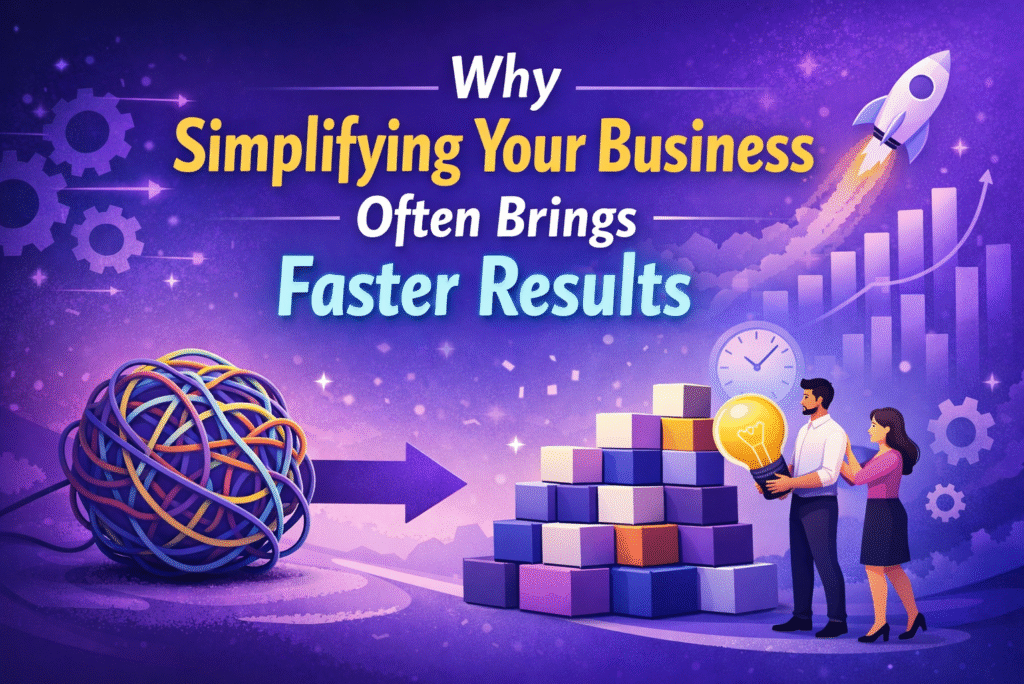
Why Simplifying Your Business Often Brings Faster Results Did you know that simplifying your business often leads to faster results? The business owners who were getting the fastest results weren’t the busiest ones. They weren’t launching five offers, posting on ten platforms, or juggling endless tools. They were doing fewer things—but doing them exceptionally well. That’s when clarity hit: Results don’t come from doing more—they come from simplifying what truly matters. In a hustle-driven world, complexity is often mistaken for growth. Business owners keep adding—services, tools, platforms, strategies—believing more will create momentum. But sustainable growth begins with simplifying what matters most and executing it exceptionally well. Simplifying your business is one of the most powerful—and underrated—growth strategies. When done intentionally, simplification leads to clarity, focus, speed, and measurable results. The Hidden Cost of Complexity in Business Complexity creeps in quietly, it slows growth You add a new service because a client asked for it. You join another platform because “everyone’s there.” You try a new strategy because it worked for someone else. Soon, your business looks full on the outside—but feels heavy on the inside. Complexity Creates: Slower decision-making Scattered focus Inconsistent messaging Team exhaustion and disengagement Confused customers When your business is complicated, progress feels heavy. Every action takes longer, every change feels risky, and results take time to show up. Why Simplicity Accelerates Business Growth Simplification removes friction. And in business, less friction equals faster momentum. Here’s how simplifying your business directly impacts speed and results: 1.Clarity Makes Decisions Effortless When your business is simple, decisions stop draining you. You’re no longer asking: “Which offer should I promote today?” “Who exactly am I talking to?” “Which tool should I use now?” You already know. Your offer is clear. Your audience is clear. Your goal is clear. Clear offerings, clear audience, clear goals = faster execution. And clarity speeds everything up. Businesses that grow quickly are not always smarter—they are clearer. 2. Focus Is the Real Growth Hack Most businesses don’t fail because they lack ideas. They fail because they chase too many at once. When you simplify, you’re forced to focus. One main offer. One clear audience. One primary platform. Suddenly, your effort goes deeper—not wider. And depth is where real results come from. Depth beats width in early and mid-stage business growth. Focused businesses: Execute better Learn faster Improve consistently See results sooner 3. Simple Businesses Are Easier to Understand (and Buy From) Think about the brands you trust instantly. They don’t confuse you. They don’t over-explain. They don’t try to do everything. If your website, LinkedIn profile, or pitch tries to explain everything you do, your audience struggles to understand how you help them. However simple businesses communicate: One clear problem One strong solution One clear next step (CTA) When customers instantly “get it,” trust builds faster— And trust is what converts. 4. Simplified Systems Save Time and Energy Here’s something no one talks about enough. Every tool you add takes mental space. Every process you complicate steals time. Simplified businesses use: Fewer tools Cleaner workflows Repeatable systems That means less firefighting and more growth-focused work. You don’t need more productivity hacks. You need fewer moving parts. This reduces: Decision fatigue Training time Operational errors As a result, you spend less time managing and more time growing. 5. Simplicity Improves Consistency (and Consistency Builds Results) Growth isn’t driven by one big move—it’s built through consistent small actions. Complex businesses lose momentum because processes change, messaging shifts, and teams feel overwhelmed. Simplification creates stability. And consistency in: Content Marketing Client experience Service delivery …are what compounds into faster, sustainable results. Why Overcomplication Feels Productive (But isn’t) Let’s be honest. Complexity feels like effort. It looks like ambition. More strategies. More plans. More action. But activity isn’t progress if it lacks direction. Simplifying doesn’t mean lowering standards. It means choosing impact over noise. What Simplifying Actually Looks Like Simplification isn’t dramatic. It’s intentional. It looks like: Removing services that drain energy Saying no to platforms that don’t convert Strengthening one offer instead of launching five Refining your message until it’s impossible to misunderstand Growth often comes not from adding—but from subtracting. Simplifying doesn’t mean doing less—it means doing what matters most. How to Simplify Your Business (Practical Steps) Here are actionable ways to simplify without slowing down: 1. Streamline Your Offerings Ask yourself: Which service generates the highest revenue? Which service delivers the strongest results? Which service clients value the most? Focus on your core offer. Pause or eliminate the rest. Specialization drives faster, more sustainable business growth than diversification. 2. Clarify Your Ideal Audience Trying to serve everyone slows growth. When your ideal client is clearly defined: Marketing becomes easier Messaging gets sharper Sales conversations get shorter One clear audience builds trust faster and converts quicker. 3. Simplify Your Marketing Channels You don’t need to be everywhere. Choose: One primary platform (e.g., LinkedIn) One core content style (posts, blogs, videos) One main CTA Master one channel before expanding. 4. Build Simple, Repeatable Processes Document: How you onboard clients How you deliver services How you follow up Clear processes replace constant decisions and create room for growth. Simplify Your Messaging Your business message should answer in one sentence: Who you help What problem you solve How you solve it If it takes a paragraph to explain, it’s time to simplify. Real Growth Comes from Subtraction Many successful businesses didn’t grow by adding more—but by removing what didn’t work. They simplified: Their offers Their strategy Their messaging Their operations And in doing so, they created space for focus, creativity, and speed. Simplicity is not a lack of ambition. It’s strategic discipline. Conclusion: Simple Businesses Move Faster If your business feels stuck, overwhelmed, or slow, the solution may not be a new strategy—but a simpler one. Simplicity isn’t a shortcut. It’s a strategy. A disciplined one. Ask yourself: What can I remove? What can I streamline? What deserves my full focus right now? Because when your business becomes easier